

Iran crisis jolts Indian exports, tourism takes a hit
Trump’s two-week promise: Hope or hype
Iran crisis jolts Indian exports, tourism takes a hit

At a time when unpredictability defines global politics, even a hint of stability can calm markets. US President Donald Trump’s recent remark that the Iran war could end within “two or three weeks” has done precisely that. Markets responded with cautious optimism.
His assertion that no formal deal with Iran is necessary, coupled with the suggestion that the United States would “leave very soon,” signals a possible rapid military disengagement. Even his claim that the Strait of Hormuz would reopen automatically after a US withdrawal has added to hopes of de-escalation.
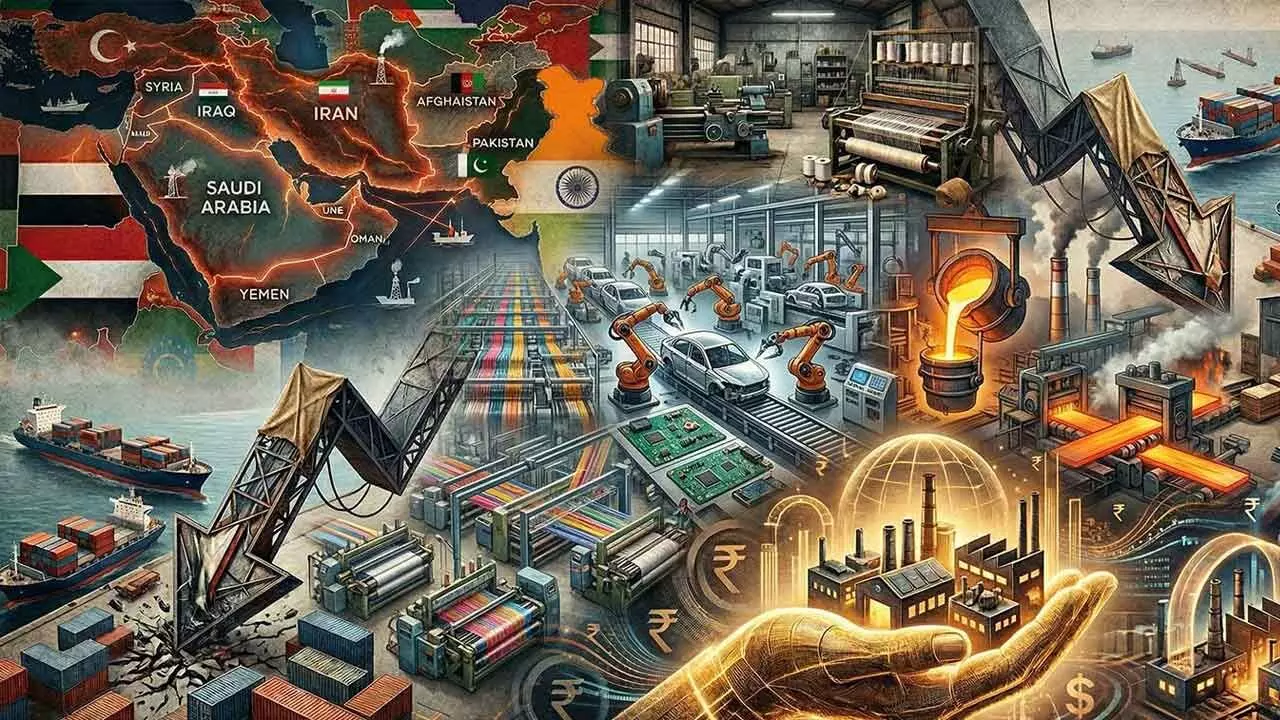
Yet, beyond the immediate relief, this crisis has laid bare a deeper and more uncomfortable truth: globalisation, while creating opportunity, has also made local economies acutely vulnerable to distant conflicts. For India—particularly export-driven states like Gujarat—the Iran war has become a real-time stress test of economic resilience.
At the centre of the disruption lies the Strait of Hormuz, through which nearly a fifth of the world’s oil flows. More than just an energy artery, it is a vital global trade corridor. Any disturbance here triggers a cascading effect—spiking fuel prices, inflating insurance premiums, disrupting shipping routes, and ultimately eroding export competitiveness.
No state illustrates this vulnerability more starkly than Gujarat. With major ports such as Kandla Port, Mundra Port, and Pipavav Port acting as gateways to West Asia, Africa, and Europe, Gujarat accounts for a substantial share of India’s exports—spanning petrochemicals, pharmaceuticals, ceramics, textiles, and gems and jewellery.
The current disruption is already evoking unsettling memories of the COVID-19 shock. Industrial clusters in Morbi, Ahmedabad, and Surat are facing production slowdowns due to shortages of industrial gas.
Labour migration—once again—has begun to surface as workers return to their hometowns amid uncertainty. In Ahmedabad’s industrial hubs such as Naroda and Vatva, chemical units are grappling not just with supply disruptions but also with workforce instability triggered by LPG shortages.
For exporters, the blow is twofold. Rising crude prices have increased input costs, while freight charges have surged sharply. Shipping rates have climbed by as much as 40%, driven by higher fuel costs and steep war-risk insurance premiums. For sectors operating on razor-thin margins—such as Morbi’s ceramics, Surat’s textiles, and Rajkot’s engineering goods—this is not just a setback; it is a direct threat to survival.
Equally damaging is the breakdown of supply chain reliability. Ships are being rerouted or delayed due to security risks, undermining delivery schedules. In global trade, timing is often as critical as pricing—missed deadlines can mean lost markets.
The financial strain is also visible. Export payment cycles have stretched, prompting the Reserve Bank of India to extend export credit timelines up to 450 days. While this offers temporary relief, it underscores the severity of liquidity stress in the system.
Surat’s diamond industry—highly sensitive to global demand and logistics efficiency—is already witnessing declining orders and shipment delays. Gulf markets, traditionally strong consumers, are themselves under stress, compounding the slowdown. Similarly, clusters like Morbi and Rajkot risk losing their cost advantage in key markets across Africa and the Middle East.
The ripple effects are not confined to Gujarat. Export hubs across India are feeling the heat. States like Maharashtra (auto and engineering), Tamil Nadu (textiles and electronics), and Punjab (agriculture) are grappling with delayed shipments and rising costs. Even Telangana is witnessing disruptions in pharmaceutical exports.
Currency pressures add another layer of concern. A weakening rupee, coupled with reduced demand in Middle Eastern markets, threatens export earnings. Any sustained disruption could also impact remittance flows, which play a crucial role in supporting domestic consumption.
The tourism sector, too, has taken a severe hit. This is typically a peak outbound travel period for Indians, but safety concerns have led to widespread cancellations. Governments worldwide have issued advisories against travel to Gulf destinations. Industry estimates suggest that 23–38 million fewer tourists could visit the Middle East in 2026, with arrivals dropping by 11% to 27%. The financial implications are staggering, with losses estimated at around $600 million per day, affecting airlines, hotels, restaurants, and allied industries.
If there is one clear lesson from this crisis, it is this: India’s export model remains deeply dependent on fragile global supply chains and geopolitically sensitive routes.
The response must be both immediate and strategic. In the short term, exporters need financial cushioning, faster credit flows, and targeted support to offset rising logistics costs. Policy interventions—such as extended credit timelines—are steps in the right direction but need to be complemented by sector-specific relief.
Over the long term, India must rethink its trade architecture. Diversifying export markets beyond the Gulf, investing in alternative trade corridors, and strengthening domestic logistics infrastructure are no longer optional—they are imperative.
Above all, resilience must become the cornerstone of India’s export strategy. In an era defined by geopolitical volatility, competitiveness alone will not suffice. Adaptability will determine survival.
For Gujarat’s exporters—and for India as a whole—the message is unmistakable: globalisation brings opportunity, but it also carries inherent vulnerability.
(The author is a former Chief Editor at The Hans India)





